
D880 NPN/6033 PNP power amps unmatched pair (gains 154/166)- symmetrical within 1Vp. Vpp out at 13.6V dual rail = 6Vp
power into 8 ohm load- = 6x6/8 = 4.5W mono.
Now working in stereo after the most unreal happenings of Mhz noise and weird connections! 2 days of shit as usual! Just swapping same components between would make stuff work! Matched the PNP/NPNs reasonably with my available stock.
Now at 5V, 0.2A = 1W power use. About 2.2V^2 = 4.84/8 ohm = 0.6W RMS output x 2 stereo = 1.2W RMS out. Needs a vol control but where?? Tried input, pin 1 out, pin 6 out, speakers + to gnd...all no good with 10k pots...no fine control at all...
Working as best as pos (cleanest sine), at 7V cleanest sine out at 0.25A draw (Total PSU W = 7/4 = 1.75W), it gives 4.8Vpp out for a 1Vpp in, gain of 4.8.
2.2V^2- = 4.84 / 8 ohm = 0.605W per channel max input.
Can be seen here then that the RMS output is 0.605W x 2 = 1.21W, so 1.75W - 1.21W = 0.5W is used by the rest of the circuit if 1.21W goes to speakers - about 69% of total energy.
3.6Vpp @ 20Hz
5Vpp @ 100Hz
4.64Vpp @ 1kHz
4.64Vpp @ 10kHz
4.8Vpp @ 20kHz
Lessons?..where to start!?
Connections are a joke with Op Amps - all sorts of MHz crap and oscillation - moved bits to opposite sides and stuff worked!! No logic - except BB connections..
The gain mismatch of the power pair makes little odds on symmetry! LR mismatches can be altered with diff feedback resistor.
The 33pf feedback cap removes much noise and 1 acts for both sides!
Small signal inputs are riddled with noise.
Can't get the opposite amp working for the Sallen and Key Low pass filter - input sig to low from output of 1st amp...noise etc. (would be designed for first stage gain signal being tone section).
Actually - no need - just bassier speakers as figures above show pretty flat response from 20Hz up - as datasheet shows!
---------------------------------------------
It is important to remember two properties known as the golden rules, as they help
understand the working of the amplifier with regards to analysis and design of operational
amplifier circuits.
1. No current flows into either input terminal (the current rule)
2. The differential input offset voltage is zero (the voltage rule).
However, real Operational Amplifiers (e.g. 741) do not have infinite gain or bandwidth but have a typical "Open Loop Gain" which is defined as the amplifiers output amplification without any external feedback signals connected to it and for a typical operational amplifier is about 100dB at DC (zero Hz). This output gain decreases linearly with frequency down to "Unity Gain" or 1, at about 1MHz and this is shown in the following open loop gain response curve.
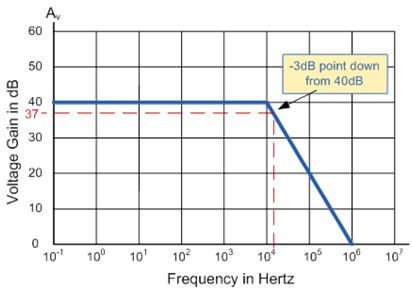
3 Bandwidth of Operational Amplifier
The operational amplifiers bandwidth is the frequency range over which the voltage gain of the amplifier is above 70.7% or -3dB (where 0dB is the maximum) of its maximum output value as shown.